
Apple's first foldable iPhone goes on sale from $1,999
3 min read
Technology / 3 MIN READ
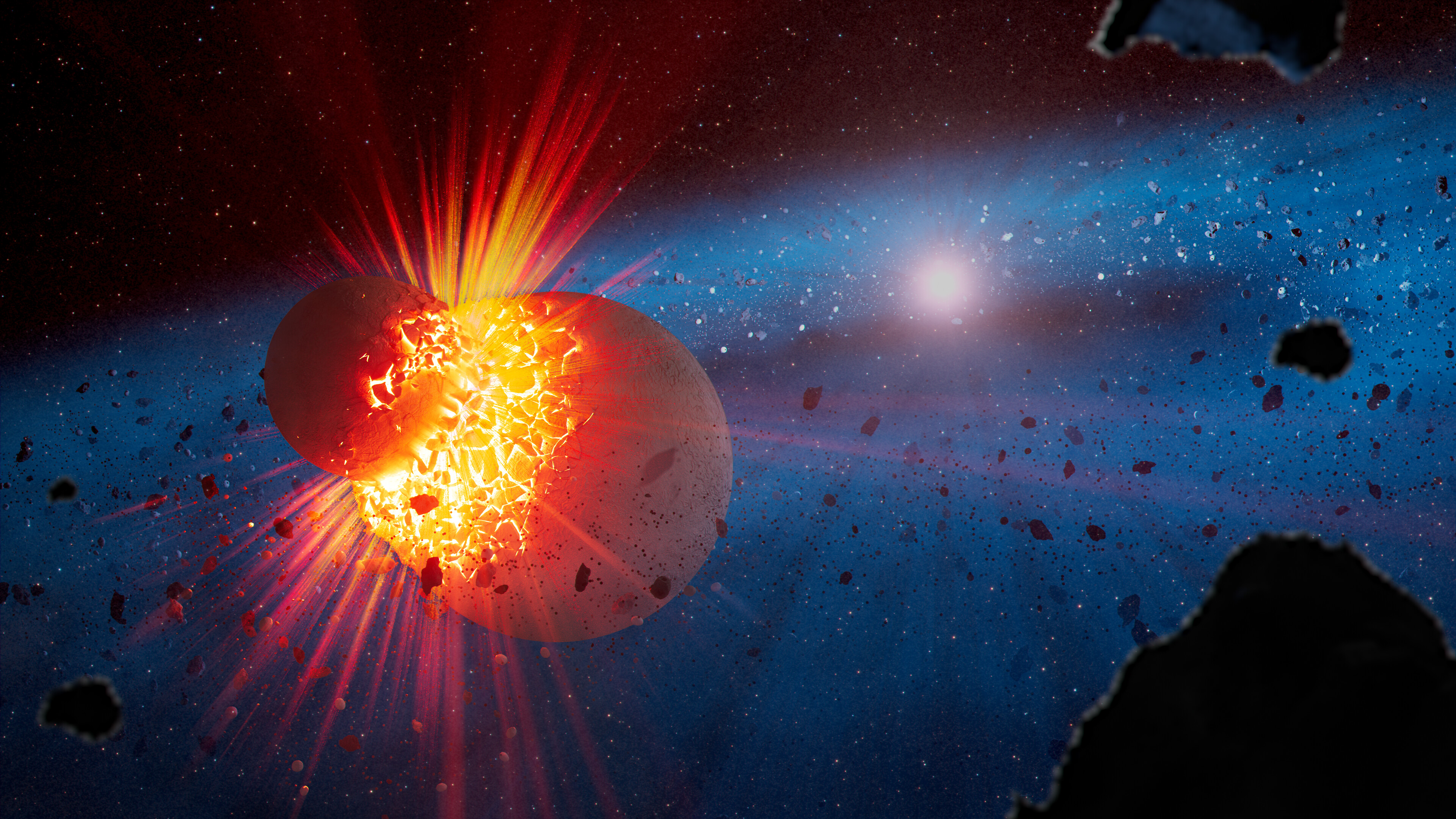
When rocky worlds smash into each other, the dust they leave behind records how violent the impact was. Astronomers have now read that record around 21 stars using the James Webb Space Telescope and earlier observations from Spitzer, and the minerals they found suggest some of those collisions involved bodies roughly the size of Mars. The study was published in The Astrophysical Journal on October 1.
The team, led by Kate Su of the Space Science Institute, studied rare structures called extreme debris disks. These are warm, dusty belts around stars whose infrared brightness can change over time, and astronomers interpret them as the aftermath of large collisions. The colliding bodies themselves are too small to image, so the researchers studied the light given off by their debris instead. Different minerals leave recognizable patterns in infrared light, which let the team identify what the dust is made of.
Webb's mid-infrared instrument observed 16 of the systems, and archival Spitzer data covered the other five. Eight of the 21 disks, or 38%, turned out to be silica-rich, with a reported uncertainty of 11 percentage points above and 9 below that figure. Those labels describe the dominant mix of minerals, since no disk is made entirely of one substance.
Silica is a useful clue because a sufficiently powerful impact can vaporize rock, which then cools into tiny glassy particles rich in silica. Silica-poor dust has a different mix, including crystals such as forsterite. By combining these mineral signatures with impact simulations, the authors suggest that silica-rich disks could come from collisions between developing planets comparable in size to Mars. Silica-poor disks could reflect collisions between smaller, roughly Moon-sized bodies, or gentler, glancing impacts. Those sizes are interpretations drawn from the dust, since the planets themselves were never seen.
The mineral difference also appeared to follow the age of the stars. Every silica-rich disk surrounded a star younger than about 300 million years, which fits the idea of an early period when rocky planets are assembled violently. Only three systems in the sample were older than that, though, and all three were silica-poor, so coauthor Attila Moór says more older systems are needed to confirm the pattern.
That picture of large early impacts echoes a leading idea about Earth's own history. Scientists think the Moon formed after a Mars-sized body, often called Theia, struck the young Earth. The new study uses that kind of event as context for reading debris around other stars, without testing how the Moon formed or catching such a collision as it happened.
By pairing mineral traces with stellar ages and impact models, astronomers now have a way to study how rocky worlds take shape during a turbulent stage that is otherwise very hard to observe.
More on these ideas